HR and L&D Leaders Predict the Top 5 Challenges for 2026

Jan 23, 2026 | 4 min read
2025 was…a lot. As our research revealed many times over the course of the year, employees were struggling. From individual contributors to the C-suite and people managers in between, last year was a doozy. Marked by rapid change, instability, and a slightly dichotomous leap into the future with increasing AI adoption and into the pre-pandemic past with a sweeping move back to the office, the pendulum swung in every direction.
As we kick off another year, we are excited to explore a new perspective and a fresh start. How can we take the chaos of 2025 and find some stability, and dare we say balance and meaning, in the year ahead?
We surveyed 1,500 respondents, primarily HR and L&D leaders, to learn what the five most anticipated challenges of 2026 will be, and it’s no surprise that ‘continued change’ topped the list. But what we noticed, in between the now usual suspects of ‘change’ and ‘technology,’ is both a glimmer of hope for a new normal and a desire for a return to the caring culture that prioritized both employee wellbeing and the bottom line.
1. Change Isn’t Slowing Down
The fact that 66% of respondents anticipate more change in the year ahead is not exactly a surprise. Just because the clock struck midnight on January 1, 2026, doesn’t change anything tangible about the challenges people are facing as the corporate world adjusts to the new normal. You know by now that this era of, well, everything, is different than in previous years and it will no doubt keep leaders on their toes as they figure out ways to continue their growth trajectory in the tumultuous months ahead.
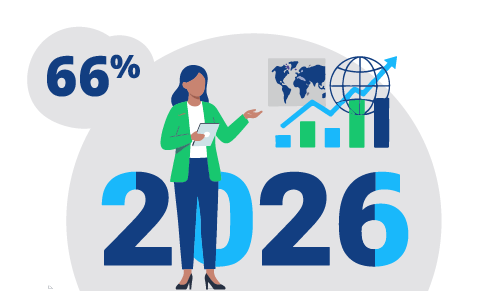
66% anticipate more change in 2026.
We found that many people lack confidence in their organization’s ability to adapt to change but nevertheless feel optimistic about their futures with the company. Leaders have an opportunity to harness this momentum and bring their people into their decision making with transparency and trust.
2. Organizational Culture Crisis
Anyone who experienced the challenges of 2025 also saw the massive hit organizational cultures took along with them. From the people-first leadership of the early pandemic (remember when it was expected, and adorable, for people to have their pets and kids on camera?) to the RTO, hiring freeze, reorg culture of 2025. This new era has people fighting rush hour again, many balancing multiple jobs without the reskilling necessary to feel truly successful. With challenging budget constraints, many organizations reprioritized valuable dollars away from learning and development which has left employees without the tools needed to lead, connect, and learn effectively in this new environment.

30% report organizational culture improvement as top challenge for 2026.
While external challenges forced many leaders to make moves they knew deep-down would be unpopular, these challenges stacked up, pushing employees to report record levels of severe stress. 2026 offers a fresh start for leaders to assess how they are doing in the culture department and move the needle back towards balance as they continue to push for performance while also acknowledging that supported employees tend to perform better.
3. Communication Still Lacking Despite Being Top Skill to Lead
Most people want more communication from their leaders. That was a theme we saw throughout 2025 but is extremely important as we move into a new year and leaders assess how they can take their businesses to the next level in 2026.

64% report communication as most important leadership skill
A lot of what makes change hard to cope with is a lack of transparency, especially when it feels like things are constantly happening without any insight or forewarning. Culture takes a huge hit when it feels like changes (such as strategy pivots, work model updates, reorgs, etc.) keep happening to people, not in collaboration with them. Showing your people that you value, trust, and care about them through transparency can be a big morale booster as you navigate the upcoming year.
If you don’t have a clear vision for the next six months due to financial instability or are contemplating a big initiative that may make some waves, say so! Who knows who may have the next big idea that can propel your organization forward, and if you don’t say anything you risk missing out on talent – and enthusiasm.
4. Technology Education Must be a Priority
While much of 2025 was spent figuring out how best to utilize emerging technologies, 2026 is going to be all about teaching, training, and leveraging. 35% of our respondents reported learning technology as a top priority. With a lot of noise about how AI can streamline and elevate, we have also seen a lot of ways that it can challenge and confuse.

35% report learning technology as a top challenge.
Getting clear on how you want your people to use these tools and training them on how to do that will help you cut through the noise and start seeing results. Striking a balance between using the latest technology strategically while also keeping things human (which is the core of any business) is the key to success.
5. Existing Optimism Can Be Used to Elevate Engagement
Somewhat improbably, despite the rocky year, 73% of our respondents reported feeling optimistic about their organization’s future. That’s great news for leaders who are seizing the opportunity of a clean slate and fresh year to invest in their people and equip them to excel in the year ahead. However, 30% of our respondents’ flagged engagement as a top challenge. There is optimism for the future and concerns about engagement. This year will be critical in re-engaging your workforce and leveraging the optimism that exists and turning it into action.

30% of L&D professionals identify employee engagement as a top challenge.
If 2025 taught us anything, it’s that the only constant is change. As we embark on a new year, undoubtedly filled with its own challenges and triumphs, investing in your people and your bottom line is the surest way to come out on top.
Wiley’s suite of professional solutions provides a structure and common language to help empower entire organizations with the skills needed to get to the next level. From building better teams with The Five Behaviors®, and improving understanding to create engaged, collaborative, and adaptive cultures with Everything DiSC® on Catalyst™, helping you make confident hiring decisions with PXT Select®, or unlocking the power of leadership at every level with The Leadership Challenge®, Wiley has innovative solutions that help make the workplace a better place.
Wiley Workplace Intelligence conducts in-depth research on key workplace issues by gathering insights from individual contributors, managers, and leaders. Wiley Workplace Intelligence then analyzes these findings to provide actionable solutions that are shared in our blog.
Did You Like This Content?
Join our newsletter to get insights, updates, and more!
